

On June 7, 1946 a handful of a new breed of “missionaries to the North” along with supportive friends met in Meadow Lake, Saskatchewan, to organize their work. The 1946 meeting was monumental in establishing NCEM, but it was not our beginning.
We look back to 1939 when Stan Collie took his first trip into northwestern Saskatchewan. And we need to go back further in time when Stan had not yet considered missionary service, for he had not yet begun a walk with his Saviour.
We must go back even further. It was a time when little was being done to reach Canada’s northern First Peoples with the Gospel. Yet God was at work, involved in the life of a man whose name does not appear among NCEM’s early members.
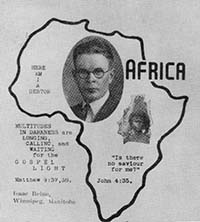 His name was Isaac Reine. A Bible school graduate, his long-range plans were for missionary service in Africa, and he had set out to work in a northern mining town to save money for future expenses. In 1937 he caught his first glimpses of Canada’s North. What he experienced impacted him greatly. He worked unloading boats and barges in Goldfields (present site of Uranium City, SK). As a committed Christian and trained preacher, it was only natural for Reine to begin evangelistic outreach in his spare time. He started a little Sunday school and, in spite of opposition and ridicule, held services in the typically sinful frontier town.
In spring Reine returned south, struck by the great spiritual needs he had seen – tent villages with no one to tell them about Christ. He had gained a burden he could not keep to himself. In the following months as he travelled preaching throughout the prairie provinces, he sought information about Christian outreach to First Nations people like those he had seen. Was anyone doing anything with them? He told audiences of his burden, and prayer warriors began being raised up on their behalf.
GOD DEALS with a HOMESTEADER
During these same years, the Lord was dealing with a certain young man and his wife. God’s people were praying for the salvation of Stan Collie. He had been driven from the “dried-out South” up to Meadow Lake, SK, to establish a homestead. Stan & Evelyn were married in 1933, but they allowed God no part in their home. Evelyn’s mother was a born again believer, but Evelyn and her brothers did not share their mother’s faith. The Collies were eking out a bare existence, yet Stan would often spend what little cash he could earn on liquor or gambling.
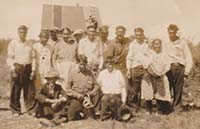 In 1935 two of Evelyn’s brothers had left for Vancouver, where each made a personal commitment to Christ. They began writing letters, telling of their new-found faith. Evelyn thought Stan would laugh at it, but he didn’t. Perhaps Stan was realizing that his life needed some changing. He began to be concerned about his sinful habits – his blazing temper and filthy profane tongue had often grieved Evelyn. Later Evelyn learned that her brothers had their churches praying for Stan – in fact, there had been prayer meetings called especially for them.
That was about the same time that Fred Smith came to the Meadow Lake district. He was an Alliance missionary candidate for South America, and had come up as an intern. Fred began services in a schoolhouse, and visited district homes on horseback. One day, while visiting the Collies’ neighbour, Evelyn’s sister happened to be there. She tried to discourage Fred from going to the Collies, fearing he would only be insulted.
However, the reception was very different. Fred even obtained a promise that the children would be at the service the next day. For two or three Sundays Stan sent Evelyn and the children. Then one Sunday Evelyn said she wouldn’t go unless Stan went too. As a final argument she burst into tears. The tears did it, and for the first time in his life, at the age of 31, Stan Collie listened to the Gospel explained.
Gradually Stan began to realize he needed Jesus. It was not easy for him to give in, but Fred kept visiting them. First Evelyn, then Stan was saved! Their immediate response was inner peace and joy they could not keep to themselves. They started a Sunday school, and Stan visited every home in the area, inviting parents to send their children to Bible camp.
Soon Stan was considering full-time Christian service, though it would be no easy decision to leave their homestead, and all he had worked for. He attended a conference in Saskatoon where missionaries spoke of their work overseas. He talked to one about serving in Africa, but was told that his growing family and lack of training would make that unlikely.
“THERE MY HEART WAS BROKEN”
The next winter Evelyn’s younger brother went north to trap, and told Stan about the First Nations who lived up there. Not many people in the Meadow Lake district knew much about that area. One day, when Stan was out clearing land, he thought, “Why couldn’t ‘I’ go down there to these First Nations people?” The thought caught him off-guard because he couldn’t think of even one reason why he couldn’t go!
Stan began looking for someone to travel with “down north” (the direction their nearby river flowed). He heard about two traders who would soon be going to Patuanak, then further upriver to their post. Stan looked them up and was told he could come along if he brought his own grub box and helped with the construction of their boats.
The stories of their adventures in river rapids, along with the Dene families who helped with navigation, were many. Most significant, Stan recalled his one-week stay at Patuanak. “It was there that my heart was broken when I saw the hopelessness,” Stan later wrote. “It was there that I said, ‘Here am I, Lord, send me.’ I knew that He loved and died for each one of them.”
Pursuing full-time ministry, and realizing their need for Bible training, Stan & Evelyn spent the following winter at a small Bible school near Meadow Lake. The summer of 1940 Stan took his second trip into the “north country,” a tour of about 550 miles with a 14-foot skiff and old outboard motor. Travelling with School staff member, Arnold McIver, the trip was planned down the Meadow and Beaver Rivers to look for a suitable location for the Collies to build their home.
Their tour began with an outdoor service and home visits at Green Lake, then on to Fort Black, Buffalo Narrows, and Dillon, each place visiting homes. Returning to Buffalo Narrows, they found considerable interest in these two “Protestant Priests,” and were offered use of the local pool hall for a service. A favourite song was “What A Friend We Have in Jesus.” The concept of Jesus being a “friend” seemed new to the listeners, Stan recalled.
Stan & Evelyn’s desire for full-time outreach was growing even stronger. They could easily have kept on farming, yet they were convinced that God was leading them north, even though there were many questions. With no arranged financial support, they sold their farm and stepped out in faith. October 1940 the Collies set out with their five children, Evelyn’s 18 year-old brother, and their scanty household effects. Stan had made arrangements for a little fishing caboose in Buffalo Narrows where they could temporarily live.
All that happened on that trip is a story in itself. The first 120 miles were by horse team and wagon, the remaining 80 miles to Buffalo Narrows by boat. One day their boat swamped, soaking their supplies – just one of the ways they were tested. The morning they arrived the fishing caboose they’d arranged for was no where to be found! A local family graciously took them in, then a log workshop became their temporary home. Their winter’s grub-stake ran out before Christmas, but Stan was somehow able to earn enough doing odd jobs around town to keep the family fed.
The Collies served alone in Buffalo Narrows for about four years, except for assistance from a lady from Three Hills, AB, who came for a time to help with the children. They began a Sunday school in their home and, along with visiting homes in the community, held weekly services. Stan & Evelyn later talked very little of the hardships of those first years: the building of a house with only their children’s help, of living on fish and cornmeal, and cleaning stables for fishermen just to survive. No church was supporting them financially.
Though content with what they had, Stan expressed frustration when he wrote, “The days seem so filled with making provision for the needs of our bodies, there is so little time for telling the Gospel story.” No doubt friends of the Collies back home were praying for them, but there may have been a lack of understanding by some about what the Collies were doing – in those days being a missionary meant going overseas, not going north.
GOD WAS FORMING A TEAM
By this time Stan had begun to realize the vast extent of the area of which he had only seen the fringe. Realizing that a lifetime would be far too short for one family to evangelize the North, the Collies began praying more intensely for a mission organization interested in expanding to the area.
The Collies’ missionary call and move to Buffalo Narrows all took place without them knowing anything about Isaac Reine. It was not until 1941 or 1942 that Stan heard that Isaac, too, had this same burden. God had begun placing together links in the chain that would soon extend Gospel outreach to neglected First Nations. While the Collies had begun their ministry, Reine continued actively influencing others to pray and consider giving their own lives to a similar purpose.
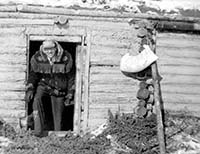 Immigrating to Saskatchewan as a child, Arthur Tarry attended Briercrest Bible Institute, graduating in 1940. Looking back, he said that two things stood out concerning his Bible school years. One was meeting a student named Martha, who would later become his wife. The other was hearing a speaker tell of the needs in Canada’s northland.
The speaker was Isaac Reine. Art recalled Isaac to be a candidate for missionary service in Africa, “but he rather spent almost all the time sharing … about the Native people in the North.” And so it was there, one morning at Bible school, that Art bowed his head and silently prayed, “Lord, if you would want me to go and reach the villages in the North for Christ, here I am. I’m ready to go.”
Reine left Caronport that day without Art getting a chance to speak to him. After graduation Art served with the Canadian Sunday School Mission, but kept a burden for the people of the North in his heart. Martha, too, had been impacted by Isaac Reine’s visit to Briercrest.
The Tarrys married in the spring of 1941, and Art took a pastorate in Lac Vert, SK. It was there that Art would again meet Reine, who had come to their community for a week of meetings. This time Art told him about how God had spoken to his heart through his visit to Briercrest.
By this time Isaac had learned of the Collies’ ministry in Buffalo Narrows, and gave Art their address. God was forming a team. Correspondence between Isaac Reine, the Tarrys and the Collies was an initial step in the formation of a missionary band. Underneath it all was a growing force of Christians across western Canada who were beginning to pray that the Lord would send workers to this mission field of which they had only recently been made aware.
Stan Collie later commented that until that time he, like Elijah, had felt he was the “only one.” But in the next few years he would meet many Christians interested in Native ministry, and many who had been praying for them. In 1942 the Collies had the joy of a visit from Isaac Reine to Buffalo Narrows. They had been corresponding but had never met. That winter Isaac spent five weeks in a village north of the Collies, while also planning a summer outreach by canoe.
In May 1944 Stan Collie met in Meadow Lake with representatives of several evangelical ministries, along with local people interested in the work. After this meeting it seemed Isaac Reine felt he could now move on to pursue his mission to Africa. He moved east for further theological studies in Winnipeg, and then to Ontario for medical training.
The Tarrys had been corresponding with the Collies and, after their third year in the pastorate, could no longer resist God’s prompting. In August of 1944, with their personal possessions packed, Art & Martha bade farewell to their congregation who assured them of their prayers.
Their trip was by train to Meadow Lake, then a 150-mile truck ride. They and their two children sat on their furniture which had been piled on top of building supplies for their home. The road soon turned into a rough winding bush trail, a long and tiring ordeal. At last, as the truck’s cargo was unloaded, the final 45-mile leg of the journey was by boat.
God was obviously at work in NCEM’s beginnings. In His sovereignty, Isaac Reine never made it to Africa. He completed his medical training, then during aviation training was killed while piloting a small plane.
UNDERLYING ROLE OF PRAYER
We don’t remember Isaac Reine for a missionary career, but as a man deeply committed to Christ’s Great Commission … a man who, by word and by example, did not shirk from challenging Christian believers about our responsibility to reach the lost. He believed in the underlying role of prayer in missions. While he was making the needs of the spiritually lost known, through prayer God was raising up a missionary band that would give many of Canada’s First People an opportunity to hear and respond to His saving grace.
To read more about NCEM’s beginnings, visit: www.ncem.ca (About Us / Our History).
